Showing posts with label Theory. Show all posts

27 January 2021

Magic Theory: Threat Diversity

(This is part of my ongoing series about Magic Theory in Old School.)

For the first post in this series, I want to discuss Threat Diversity. It's one of the highest level concepts in deck building, but the one I've spent the most time thinking about. Perhaps I'll organize the series from the top down, instead of from the bottom up.

Threat Diversity, or Why Disenchant is So Good

There are no wrong threats, only wrong answers - David Price

When I first began reading strategy articles in the late 90s, this was the common wisdom. The following 20 years of the game has only seen creatures get even better, new threat types like Planeswalker, and the answers struggling to keep up. It's so ingrained in my understanding of the game that I assumed it was always true. I'd see deck lists from the early years of the game and laugh at the perceived narrow answers the decks would play, and in such quantities! Almost every deck has 4x Disenchant, how were they ever winning?

 Since getting into Old School Magic, I've seen there is more to it than the famous David Price quote. I've come to realize that the quote was so important because of the timing of it. As Magic moved out of the early dark ages of deck building and the creatures slowly began to get better, the quote came at the perfect time to shift the thinking of the masses. That doesn't mean they were wrong before, the game was just different.


What is a threat?

In general, a threat presents an opportunity to gain a recurring advantage. Spells with one time effects are threatening but not threats, because once they've resolved they stop producing the advantage effect. Only if the spell is going to win the game on the spot can it be considered a threat. For the most part, in 93/94 threats are permanents. Creatures generate a recurring advantage by being able to attack the opponent or activate abilities. Artifacts like Black Vice, The Rack, and Jayemdae Tome provide more advantage the longer they stay in play. Enchantments like Sylvan Library and Land Tax are threats against many decks. Even Lands can be threats with the existence of Mishra's Factory and Library of Alexandria.

It's not important to clearly classify a card as a threat or not, at least when playing the game. Game play is more focused on how threatening an opposing threat is, while deck building is more concerned with which threats you expect to face. Pendelhaven can be a very big threat or completely irrelevant during a game, but if it is hard for your deck to beat you need to consider it as a threat when building your deck.

What is an answer?

Answers are defined by their ability to neutralize a threat. Some answers neutralize the threats as they are being cast, like Counterspell. Some answers remove creatures from play, like Terror. Some answers remove other threat types, Shatter for artifacts, Stone Rain for lands, etc. Also, in the David Price sense, they have no value if there are no threats to neutralize.

Some answers can neutralize different threats as the game progresses. In this way, creatures can be answers by preventing opponent attacks. A White Knight can hold back an army of goblins early on, or a larger threat like Juzam Djinn later in the game. Icy Manipulator and Maze of Ith both neutralize the most threatening attacker. 

Answer like Moat or Shatterstorm can deal with multiple threats at once. As the answers get better at neutralizing multiple cards from the opposing deck, they can be considered threats. The Abyss can completely blank an opposing creature strategy, so the creature deck sees it as a threat and requires its own answer to it. Blood Moon can prevent multicolored decks from being able to play spells at all, and thus requires an answer. Perhaps this means the best way to define a threat is something that requires an answer, but this could be a chicken and egg scenario. Are the commonly played answers common because of the commonly played threats, or vice versa? Eventually it reaches a sort of equilibrium where there isn't anything left to be discovered.

What are the threats and answers like in 93/94?

The answers available in Old School are still some of the best answers ever printed. Counterspell can stop any non-land threat in the format. Swords to Plowshares stops every creature without protection. Disenchant stops almost every non-creature threat, as well as some creatures. These represent what I call the Holy Trinity of Answers. Chaos Orb deals with all permanents.

insert image of venn diagram

Creatures are very weak, especially when compared to the available removal. No creatures generate any value upon entering the battlefield, and only a few do anything upon death. The best commonly played creatures are either very efficient, very cheap, or dodge the commonly played answers. A creature with 4 toughness dodges Lightning Bolt. A creature with Protection from White dodges Swords to Plowshares. Cheap creatures can get onto the battlefield before countermagic is available. Protection from Black avoids The Abyss, and Flying avoids Moat. 

The non-creature threats are much more reasonable. Many of these represent the few ways to gain card advantage in the format. Disrupting Scepter and Jayemdae Tome provide it in the most pure forms. Cards that can generate the recurring card advantage can run away with the game if left unanswered. The most common threat that can do this is the Library of Alexandria. Library is a very strong threat because it avoids the Holy Trinity of Answers.

How can you use this in deck building?

When choosing threats for you deck, think about how they line up against common answers. If your deck is already strong against one of the common answers, add threats that line up better against the others. Alternatively, try to overload the few copies of the correct answer the opponent has. If they only have 4 Swords to Plowshares and 4 Lightning Bolts, you can try to play only creatures with 4 toughness to effectively cut their removal options in half. Or only play creatures with Protection from White. This is usually easier said than done because of the limited card pool.

Playing non-creature threats is very appealing, but it's also worth thinking about turning on opposing Disenchants. Because the non-creature threats are so much better than the creature threats, Disenchant sees more play than even Swords to Plowshares. If you choose to play some non-creature threats, try to play more than the number of answers you think your opponent has.It can look like playing a few Disrupting Scepter in your deck can add a separate dimension, but if its your only Shatter target, maybe its better to leave them out.

Here are two lists I've built recently to try to minimize effectiveness of the opponents Disenchants (also, I love Merfolk):


Building a deck to turn off opposing creature removal is much easier, though also kind of unexciting at this point. The Deck is great, and you already know this.


Trying to make a deck that avoids both Disenchant and Swords to Plowshares is a much bigger challenge. Spell-based combo is basically limited to just Channel-Fireball, and with Channel restricted it probably isn't consistent enough to build an entire deck around (though it can add an extra dimension to other decks very effectively). Other options to ignore the white answers would be to build a straight Burn deck, or a Counter Burn deck to use Counterspell to protect your few threats from the white answers.


If you are building a controlling deck, its hard to go wrong with the full 12 Holy Trinity cards. When you branch out into other colors instead of UW, think about the Venn Diagram for which answers overlap on possible threat types.

So Much Depth

I've always enjoyed the challenge of building new decks that can beat the best decks of the format. Old School has been very enjoyable for that so far. Come back next time when I talk about Threat Density and why I think Strip Mine should be restricted!


30 August 2020

Mana bases in Middle School / Premodern

Over the past month, I've been playing in a Middle School league put on by my friends at Romancing the Stones. I had played some Premodern over the past year and I've really enjoyed the deck building space in both formats. One thing that is clear about both formats: the mana is awful. I've played two instances of Constructed Set Roulette and observed a few others. Every time, the six random sets provide better options for mana bases than Premodern or Middle School. I want to spend this post looking at what causes the mana to be so bad, what that means for deck construction, and some overlooked synergies.

Premodern vs. Middle School

The format rules for Premodern and Middle School are very similar. They both focus on the time period of Magic sets between traditional 93/94 Old School and the official Modern format. Both include an extensive banned list that allows for some classic Standard decks from this era, and some of the weaker Extended decks. There are three major differences between the two formats:

1. Premodern uses current 2020 Magic the Gathering rules. Middle School uses some rules from 1995-2003, specifically mana burn, damage on the stack, and pre-exile zone Wish functionality.

2. Premodern uses sets that were Standard legal from 4th edition through Scourge. Middle School allows Portal sets, as well as reprint sets printed in this time period like Chronicles / Renaissance and Anthologies. Anthologies allows for some strange cards to show up that you might not expect, like Pendelhaven and Hymn to Tourach.

3. The major differences in the banned cards: Premodern bans both Necropotence and Force of Will, while Middle School allows these. There are other differences that somewhat relate (Dark Ritual is banned in MS), but these are the two major ones in my opinion. Relevant to my post today, both ban Brainstorm.

I think overall I prefer the Premodern rules and cards. I much prefer using current rules without mana burn etc. I also support Force of Will being banned, if only to give the format a different feel from Legacy. I think I prefer Portal sets allowed, but I don't like the confusion of the reprint sets (Anthology specifically). However, I'm not in charge of the events, so I play what they tell me is allowed.

Historical Mana Base Context

The majority of decks that are played in these formats are decks that were played in the old Extended format. When examining the mana of these old decks however, there are some issues.

Extended was created in 1997 and allowed cards from The Dark and Revised. Importantly, this meant original ABU dual lands were legal. These are the gold standard for dual lands (see my rankings of best dual land cycles at the end of this old post) and cover all 10 color pairs. When Extended rotated in 1999 to remove Revised and 4th edition, these dual lands were excepted and allowed to be played despite not being in one of the included sets. These remained legal until the printing of Onslaught and the rotation before PT Houston in 2002. 

If you look at those dates and compare to the dates of sets covered by Premodern/MS, you see that for all but the final year of the 1995-2003 window the original dual lands were played in Extended. For those playing Premodern/MS for a nostalgic experience, it can be quite a shock that some of your favorite decks just don't function because the mana is so awful.

One reason for not allowing dual lands in Premodern/MS is to keep the price of entry down. Many of the staples of Premodern decks are quite affordable (though the reserved list exceptions are very very expensive as seen by recent Mox Diamond and Gaea's Cradle spikes). Additionally, fetch lands from Onslaught are a major part of the format and fetch-dual mana bases are too good. 

My Suggestions

I have yet to prove my case that mana in Premodern/MS is awful, but here are some alternatives I would like to suggest.

1. Allow original dual lands in the format, but ban fetch lands. This is a big hit to the affordability of the format, but restores some formerly exciting cards to their old power levels (Land Grant, Tithe, Eternal Dragon, Mirage slow fetches). Additionally, banning fetch lands is not without precedent (see Pioneer) and allows Brainstorm to be unbanned. Having to go out of your way to play cards that shuffle is a large enough cost to playability I would not expect it to be ubiquitous like in Legacy.

2. Allow the five enemy-colored fetch lands to be legal. Enemy color mana bases are significantly weaker than allied colored mana bases. This would allow them to be mostly on the same level, with the limitations being less frequently played cards like Skycloud Expanse etc. 

3. Extended the format to include Ravnica block shock lands and ban the Onslaught fetch lands. I think shock land / pain land formats are the best for mana bases, balancing between aggressive, controlling, and midrange strategies. Additionally, I think a lot of the classic Extended decks I remember include cards from some of these sets. Including Time Spiral and Timeshifted cards lets you add even older cards in a roundabout way. The real shift in design wasn't with card frame change and either came in Lorwyn block with Planeswalkers (these 5 are mostly harmless), or Alara block with Mythic Rares. You lose the appeal of only old card-frame, but the formats already allow new-framed printings. I personally would select a set through Eventide and call it Pre-Mythic.

There are many ways to mix and match some of these ideas, and I want to encourage those running events to think outside the box and not just do something that someone else prescribes without agreeing 100%.

The Mana

After 1000 words, we finally get to the good stuff. I will look at the tools available in Premodern/MS and discuss the implications of them with regards to deck building.

Fetch Lands

Fetch lands from Onslaught


Fetch lands without dual lands to fetch are not very good. I ranked them 9th when I ranked dual land cycles six years ago. I still think that ranking is accurate. Fetch lands fail to support decks with CC cards in more than one color. It is greedy to expect to be able to play both White Knight and Counterspell on turn two with a given mana base, but it is not unreasonable to expect Counterspell and Wrath of God. A turn one fetch land can only help cast one of those cards, and the decision sometimes must be made before you know which other lands you draw. Fetch lands require a lot of shuffling as many others have noted, but that isn't a big issue in a format that isn't played under the tightest rules enforcement levels. B
The format with fetch lands as the primary dual lands leads to some interesting ramifications. 

1. Decks almost always have a primary color and a secondary color supported by the fetch land. This secondary color can't have too many cards with CC in the cost. This limits which cards are playable in the format.

2. All the fetch land decks play lots of basic lands. I've seen lists with up to 16 basics. This means the card Wasteland is surprisingly ineffective. Other cards like Blood Moon, Back to Basics, and Price of Progress see almost no play. While this might be seen as a good thing, I think it stifles creativity and risk taking. I like when the format lets you take risks on playing a third or fourth color but you can get punished. I also like when you can mitigate the risks by choosing to play a one or two color deck. This format makes those choices for you.

Wasteland isn't very good in this format

3. Enemy colors don't have these. Allied colors are preferred.

4. Brainstorm must be banned if these are legal.

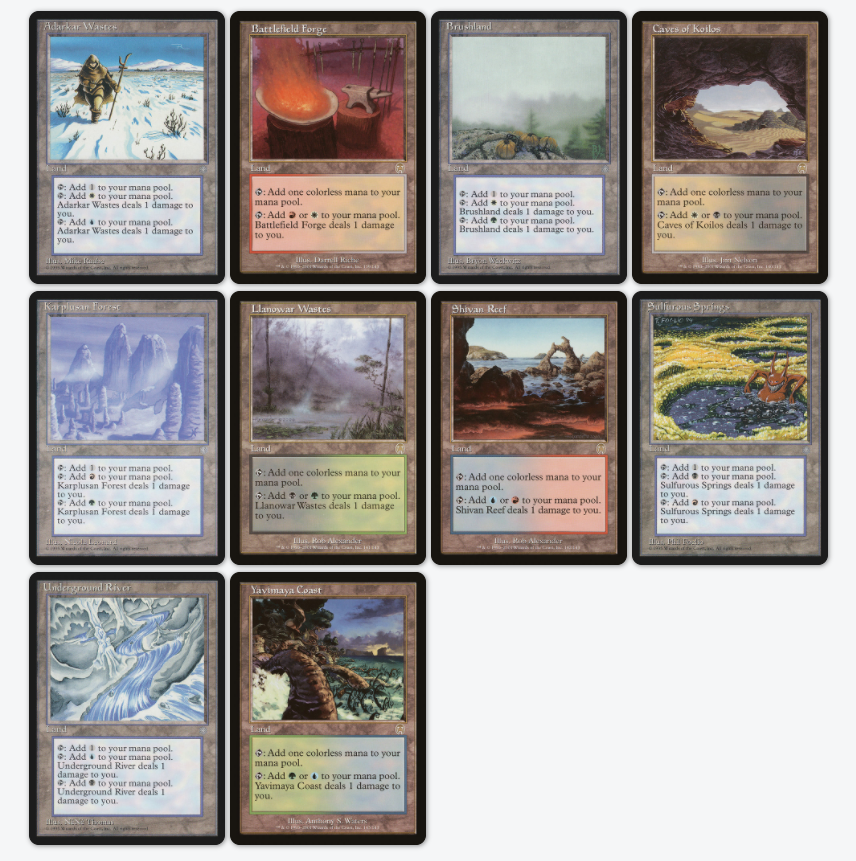
Pain Lands

Pain lands from Ice Age and Apocalypse

From the first printing in Ice Age until the printing of shocklands in Ravnica, these were the essential dual lands for Standard. I ranked them 3rd when I ranked cycles, which may have been too high, but they are effective. I wish these would see more Standard play in current formats.

These are the default lands you will see in just about every two-color deck. They skew aggressive, but control decks likely won't have more than four in the entire deck so the drawback is manageable. If you plan on playing a lot of Premodern/MS, you should pick up a set of 40 of these. They are also fairly affordable since they don't see play in many other formats.

Filter Lands

Filter Lands from Odyssey


These aren't very good (I ranked them 10th in my post from six years ago). They do two interesting things I want to point out.

1. They turn colorless mana into colored mana. This is useful for things like Mishra's Factory and Skycloud Expanse in Landstill decks. Also makes the colorless option from pain lands better.

2. They only exist in allied colors, further skewing the metagame to only allied color decks.


Mirage Fetches and Invasion Duals

Fetch Lands from Mirage and ETB Tapped Lands from Invation

I group these together because they have almost identical functionality in Premodern/MS. It's hard to believe, but the printing of Coastal Tower et al. was a pretty big deal in the day. The Invasion lands are almost always better than Mirage except against the non-basic hate cards. Both are weak enough you should never play them.

There are some other cycles of dual lands I won't go over in detail, but they are almost all strictly worse than the ones I've discussed above. These include Ice Age depletion lands, Homelands filter lands, Tempest ETB tapped pain lands and delay lands. Avoid at all costs.

Lairs

Lairs from Planeshift


These are a personal favorite of mine in Premodern/MS. These may look awful at first glance (and in the realm of all of Magic, they are terrible indeed), but there are specific reasons why they are better than they look.

1. They are the second (or third) option for enemy colors. Don't look at them as three color lands, but as enemy dual lands with significant drawbacks. Crosis's Catacombs is Volcanic Island when you squint hard enough. As we've seen above, there is a dearth of options for enemy color decks.

2. The draw back is real, but manageable. Because of the card Counterspell, you notice the majority of spells in Premodern/MS fall in the one and two CMC range. These lands let you cast those two mana spells on turn two, and if your deck isn't trying to cast a four mana spell, the drawback won't be that painful.

3. There are some interesting ways to use these for real or psuedo-advantage. Using these with Mox Diamond can let you cast a variety of spells of different colors with CC requirements starting on turn two. (Turn one basic, turn two lair plus Mox you now have a very solid manabase.) They can also be used with Thawing Glaciers to fix mana further without being set back at all. (Turn one Glaciers, turn two Lair activate Glaciers with the trigger on the stack, then return the Glaciers with the Lair.) 

Here are two decks that take advantage of lairs (or could take advantage):

RW Tax Rack by Nathan Golia

Turboland by Ty Thomason


The RW tax deck could use Lairs to fix the mana while still letting Land Tax trigger. Additionally, it wants to cast Devestating Dreams as well as some WW spells like Soltari Priest. Rith's Grove can help this deck a lot at casting spells while the drawback isn't as severe.

The UG Turboland deck uses the aforementioned Thawing Glaciers trick, as well as Explore plus Horn of Green to turn Treva's Ruins' drawback into a benefit.

5 Color Lands

The playable 5 color lands in Premodern / Middle School

These are somewhat reasonable as second or third options in enemy color decks. They also enable some five color strategies. None are so good to be widely played, but they show up when you need them. Keep them in mind. Note that Gemstone Mine works well with Lairs

The Artifacts

Lotus Petal and Mox Diamond

The Diamonds from Mirage are also playable in a pinch, as is Mind Stone from Weatherlight. The Medallions from Tempest can be used with the untap mechanic in Urza's Sage to solid effect. Lotus Petal can enable some fast starts, but Mox Diamond is the real star.

Mox Diamond has a lot of synergy with the land return cards from Masques block, mainly Daze and Gush. There isn't much incidental hate for it. Mana costs being low means drawing extra isn't that much worse than drawing extra lands. I'm going to be exploring some more in the Mox Diamond space in the future.

Fast Mana

These all tap for two mana!

Like the five color lands, you will know when you want these. These are ways to get out of the one and two mana spell fest that is the rest of the format. Dark Ritual is also worth mentioning here, but it is banned in Middle School.

Thawing Glaciers

Thawing Glaciers, AKA Slowest Fetch

This card is pretty good at getting your splash color in a two or three color deck. It also is very important in control mirrors where making land drops is vital. It can fuel Dust Bowl (if Dust Bowl was any good) or combo with Lairs. I think this card should see more play in general.


Other lands to remember

Creature lands like Mishra's Factory and Treetop Village are big parts of the format. Gaea's Cradle is very good, but Tolarian Academy is banned and Serra's Sanctum not that great. Rishadan Port and Dust Bowl might be better than Wasteland. There are still a lot of lands that might be okay if you give them a chance. I didn't think Lairs would be playable at all until I put them in my deck; now I'm looking for more ways to play them.

Some future programming notes

I've recently started school. This combined with working part time will probably take up more of my free time than before. I don't know how much Magic I'll actually be able to play, and even more skeptical about how much time I'll have to write. So this may be my last blog post for a while.

13 August 2020

Thoughts on Growth Spiral and other ramp cards

I hadn't planned on writing anything about the latest Standard bannings. Overall, I felt like they did a good job, even if it was a few months too late for most of them. I've always advocated for banning Uro over banning Growth Spiral, but as long as one goes I think it should be enough.

In the week since, I've spent some time thinking about exactly why Growth Spiral was so strong. I've seen a lot of arguments making a variety of cases. I want to talk about these arguments and why they are valid or why I think they are missing the point. I also want to bring up a few things I haven't seen as often that I think do a lot to explain the dominance of Growth Spiral.

This may be a bit heavy on some theory, but I hope I can get my point across.

*Begin Theory*

What is Ramp?

The "one land drop per turn" limit is one of the most important rules in Magic. It is the way a cards mana cost dictates what turn it can see play. Without the growing nature of incremental mana increases, the game would be completely different.

There are several ways to play a card on a turn before it's mana cost would normally allow. These ways can be split into four categories. I will call them Ramp, Ritual, Tron, and Affinity.

Affinity refers to any cost reduction mechanic. Affinity for Artifacts is the classic example, letting you play a 7cc Myr Enforcer as early as turn 1. The Medallion and Familiar cycles from Tempest and Invasion would be in this category, as would Marauding Raptor and Grand Arbiter Augustin IV.

Tron refers to special lands that produce more than one mana when activated. These lands usually require some setup (like Tron, Tolarian Academy, and Lotus Field) or restrictions on mana type (Mishra's Workshop, Ancient Tomb, and also Tron).

Ritual refers to a one-time boost of mana, usually coming at the expense of card advantage. Dark Ritual, Black Lotus, and Ancient Spring are examples.

Ramp refers to a permanent increase in the amount of mana you have. This can come in one of three forms: Mana Rocks (Azorius Signet, Mox Ruby, and Coalition Relic are examples), Mana Dorks (Birds of Paradise, Noble Hierarch, and Llanowar Evles are examples), and Land Ramp (Rampant Growth, Farseek, and Cultivate are examples).

Growth Spiral, Explore, and other similar cards don't necessarily fall into one of these four categories, but they mostly resemble Ramp when they work as intended. 

How to use Ramp cards

Mana Rocks can be used to power out expensive spells, but are more commonly used as fixing and ways to fill out the curve. They are less about accelerating into a game-breaking 6+ mana cost spell and instead about ensuring a deck gets to four mana and then reliably casts 4cc spells the rest of the game. These usually run between 24-26 lands. Example Deck

Mana Dorks are usually used to power out 3cc and 4cc creatures on turns 2 and 3 and then turn into attackers themselves when there is nothing left to cast. These decks run much lower land counts (20-23) and tend to be more aggressive than Mana Rock and Land Ramp decks. Example Deck

Land Ramp decks are trying to cast an expensive game-changing spell as fast as possible. Usually, this spell is Primeval Titan, but it can be anything similarly powerful. Example Deck. These decks run 26+ lands due to what I like to call The Fundamental Rule of Land Ramp:

The Fundamental Rule of Land Ramp: A land ramp spell is only useful if you are still making your land drop for the turn.

Land Ramp decks need to cast their big splashy spell *early* to have success. The Mana Rock and Mana Dork strategies can still execute their game plans adequately when they don't have the follow up land drops. Mana Rock and three lands is enough, Mana Dork and two lands is enough. The Land Ramp deck usually needs a combination of six Lands and Mana Ramp cards, preferably four lands two Ramp cards.

When I look at the various Growth Spiral decks in Standard the past two years, I see much more similarities to Mana Rock decks than I see similarities to Land Ramp decks. The main exception is the Field of the Dead / Golos deck from when Field was still legal for play.

Mulligans, Explore, and Rampant Growth

Ramp decks mulligan poorly, but topdeck fairly well. 

I've played a fair share of Primeval Titan ramp decks in the past. The card Explore has been always been an option, but I've usually decided to not play it. My main issue with the card is it's reliability. Consider a hand of three land, Explore, Sakura-Tribe Elder, and two Primeval Titan. On the play, this hand can cast a turn four Titan whenever you draw two land over four draw steps (three draw steps for turn, one from Explore). With 27 lands in the deck, this is about 61% of the time. If the card Explore is replaced with Farseek. you only need to draw one land over three draw steps to cast turn four Titan. This happens about 81.8 % of the time with a 26 land deck.* 

Now, this is a specific scenario I've cherry picked to show the advantages of Farseek over Explore. Explore has advantages too, mainly when you topdeck in the late game with enough mana to cast everything. But Explore also had another downside that was a bigger issue for me. When you mulligan with the deck, especially to 5 or fewer cards, Explore becomes much worse. Explore only gives you the extra land drop the turn you cast it, so a hand of two land, two Explore (lol), and Primeval Titan is significantly worse than two land, two Farseek, and Primeval Titan. Also depending on your interactive spells, it can be way better to have Farseek and guarantee having three mana on turn three to cast Anger of the Gods than it is to roll the dice and hope to draw a land over two draws. 

For these reasons, I've shied away from using Explore in a dedicated Land Ramp decks. Others have had success with it, and maybe they are right that the benefits outweigh the downsides, but this is how I've seen it for the past decade or so.

The difference between a deck that HAS to get to six mana vs one that just wants to get to four or five more consistently can be seen in these two lists.

RUG Control


Valakut

The first deck is playing a much more interactive, controlling style using Explore more as a Mana Rock. It does have a 6cc Titan, but it is not imperative that it comes down on turn four. The second deck is a classic Land Ramp deck that only plays two explores (lol) despite having 28 lands in the deck, instead choosing to play Overgrown Battlement and Green Sun's Zenith to have more hard ramp spells.

*End Theory*

Growth Spiral in Standard

Why was Growth Spiral so oppressive in Standard? I think it has less to do with the Ramp aspect and more to do with the surrounding cards. Lets look at two more recent lists.


Esper Control


Bant Control


I chose to use two lists from the same player instead of maybe better performing lists to get a sense of the internal consistency in the deckbuilding choices. I want to focus on Growth Spiral in the Bant decks because it's less of a combo enabler like the Temur Reclamation deck. Wilderness Reclamation is itself an incredibly powerful Ramp card that adds some complications to discussing the raw power of Growth Spiral.

I think both of the lists above by Andrea Mengucci are very similar. Both are controlling strategies looking to stabilize and end the game with planeswalkers. When you compare the numbers, both have similar amounts of 5cc+ spells. The Esper deck had four Teferi, Hero of Dominaria as well as two Command the Dreadhorde. The Bant deck has two ECD, two Nissa, two Shark Typhoon, and two Hydroid Krasis. The difference in the decks is how they plan on getting to the point in the game of casting these 5cc cards. 

The Esper deck plays a traditional control role, using early disruption like Thought Erasure, Cast Down and Oath of Kaya to disrupt the opponents early plays. It has Kaya's Wrath to clean up the board if it gets out of hand. Once the board is stabilized, Teferi Hero of Dominaria can take over the game.The Bant deck has the same end game of the control deck, but gets access to eight Explores. This means it doesn't need as much early interaction, it can skip that stage of the game.

4 Thought Erasue, 4 Cast Down, 3 Oath of Kaya, 3 Basilica Bell-Haunt, 1 Despark, 3 Kaya's Wrath, 2 Elderspell = 20
4 Growth Spiral, 4 Uro, Titan of Nature's Wrath, 2 Aether Gust, 2 Dovin's Veto, 1 Brazen Borrower, 2 Mystical Dispute, 2 Shatter the Sky, 3 Land = 20

I think Growth Spiral functions more as a Mana Rock in a controlling deck than a Land Ramp card in a Ramp deck. Cards like Nissa, Who Shakes the World and Elspeth Conquer's Death are still reasonable plays on turn five without any ramp. The deck uses the accelaration from Growth Spiral and Uro in lieu of interacting early. It plays just enough early interaction for the games it doesn't draw one of the Explore effects.


Other Arguments about Growth Spiral

I want to mention a few things I've seen other people argue for why Growth Spiral was so strong. 

First, the instant speed nature. The argument goes that it is significantly better than Explore because it lets you hold up mana. I think by the end of the Standard format this argument was fairly well debunked. The instant speed is certainly a benefit, but I don't believe it to be the main reason it seems much more powerful than Explore. Explore was used in similarly powerful ways when it was in Standard as I showed above. The decks that use Spiral at the end of the format weren't playing cards like Quench to leverage the flash aspect, and playing against Spiral decks wasn't that tricky with regard to instants on your turn (at least, not because of Growth Spiral instants). The Bant deck above is largely a tap out control deck. The additional color requirement of Blue compared to Explore was largely irrelevant in Standard because Blue and Green were probably going to be in your deck anyway.

Second, that Spiral is hard to interact with compared to Mana Dorks. Mana Dorks can be Shocked or Bolted on turn one or two (always Bolt the Bird) to disrupt their effectiveness.  A turn three Mana Dork in a deck with nothing costing more than 4cc has been effectively neutered. However, I don't think this comparison is reasonable. Mana Dork decks look nothing like Growth Spiral decks. I will say in the games I've played post-ban that countering turn three Uro has been a very strong play, so maybe the issue was that there was too many to reliably disrupt (see the next point).

Third, that you can play eight copies of the card. I think this has more merit than the other two arguments, but I'm still skeptical to the extent. Eight copies means its harder to stop from happening, but I'm not sure you would actually put all eight copies of the card Growth Spiral into the Bant deck. The strength here is that Uro lets you dilute your deck with 29 lands and 8 Explores while still having a reasonable amount of late game threat density. This is the reason I advocated for an Uro ban instead of a Growth Spiral ban, but I do see the reasons for leaving Uro around into future Standard.

Fourth, the lack of pressure from other decks. This one I actually agree with. The biggest threat to Ramp decks in the past has been very aggressive aggro and reliable countermagic for late-game threats. Teferi, Time Raveler basically removed all hard late-game counterspells from the format. The lack of aggressive one-drops is another issue. Aggro decks can try to "go under" the Growth Spiral decks, but don't have the tools necessary. If your best aggressive creatures don't come down until turn three or four, why would you choose that over just playing Growth Spiral yourself?


Final Word on Growth Spiral

I don't think Growth Spiral is an objectively over-powered card. It would not have needed a banning in a different Standard format without Uro. Perhaps even a different banning philosophy would have let it stick around. I still think this is a good choice to ban for the last few weeks of this Standard format. I think a card like it can be printed again in the future, but it would be important to only have one in the format at once.

I hope I've explained my thoughts and theories adequately on this card and ramp cards in general. If you have any questions on something I may have not explained adequately, feel free to leave a comment or reach out to me on Twitter @ceciliajupe.

-Ty


*Note on the math here: I ignored ETB tapped lands and ramp redraws. Ramp redraws really help the first hand a lot, but also negate the relevance of Explore. Perhaps having both is better and I'm completely wrong. I originally posted with incorrect percentage for the Explore case.

17 September 2019

Revisiting Magic Theory in Old School

I love playing Magic, but I also love thinking about Magic. One of the biggest appeals of the Old School formats is all the thinking you can do. There aren't many resources for deck lists and content available, so most of the time spent thinking about the format has been on my own. I've only played Old School in one tournament and one get together, as well as a few games in between rounds at a Modern tournament. I've spent far more time thinking about decks than I have playing games,

Another appeal of Old School is the static card pool. As much as I would like to have a certain card or certain tools available in deck building, I will always be limited to the cards as they are today. This can be frustrating when I don't have access to anything that does what I desperately need, but it does force me outside of my comfort zone as a deck builder to try things I'm not quite comfortable with. This has led me to spend more time thinking about the theoretical concepts behind deck building.

I want to start a series of posts about Magic theory with a strong focus on Old School. Given the nature of the format, much of the fun is in building decks as opposed to playing games. Games aren't quite as deep and interesting given the extreme swinginess of the restricted cards and lack of strategic options. Deck building is how you win the game before you play the game. I like to say "You never want to lose a game in the deck building phase."

I will hopefully cover most of the topics I originally discussed here. I don't expect anything to be groundbreaking or revolutionary. It will likely be refresher to things people already know, or possibly obvious things that don't necessarily need to be spelled out. I'm mainly going to do it as a way to organize my internal thoughts in a manner that hopefully flows logically.

I'll update this post below each time I add an entry in this series.

-Ty

Posts about Magic Theory

Definition of Terms (old)

18 June 2019

Five Things I've Learned From Nathan Zamora

My longtime friend Nathan Zamora is getting married this weekend. I decided to take this opportunity to mention some memorable Magic lessons that I learned from him over the years. Nathan is one of the most naturally talented players I've ever met and a fierce competitor. He was a terror on the Texas PTQ circuit in the early-to-mid 2000s. I learned many great lessons from watching him play and playing against him, particularly in constructed. Together, yet separately, we somewhat helped make recent SCG Invitational Champion Collin Rountree into the player he is today.

Lesson One - Having a Sideboard Plan


There are plenty of humorous stories surrounding Nathan, mostly involving his antics oustide the game or his loud personality. This one is a particular favorite of mine because the humor comes entirely from the game play.

There was a $1K Standard event held at Midnight Comics back when Legions was the current set. This was shortly before Regionals so many people attended to get a warmup event (you rarely played Standard outside of Regionals back then). Nathan brought a RW Astral Slide deck that was popular at the time. In fact, I was playing a similar list in the same event, but I scrubbed out as I did in most constructed events back then. After I dropped, I watched Nathan play for the rest of the event. 

His opponent was playing Mono Black Control. This was a very bad matchup for Astral Slide due to the existence of Haunting Echoes. All the MBC deck needed to do is resolve an Echoes in the mid game and the Slide player would be out of resources to win the game. Predictably, game 1 goes this way. The early Exalted Angel is answered by Chainer's Edict. The furious cycling just helped set up the Diabolic Tutor for Haunting Echoes, and Nathan was down a game in short order. 

Nathan immediately opens his deck box and practically slams all 15 cards into the deck. Unlike other times though, this wasn't just for show. He brought in all 15 cards. Once the shuffling was completed, the second game began. Nathan led with a cycling land, his opponent a swamp. A mountain followed by another swamp. A plains from Nathan and a turn three Stone Rain. The opponent just played another swamp. Another land for Nathan and he casts Lay Waste. The opponent could only manage to play a meager Cabal Coffers. Another Stone Rain, still going after the swamp. Now you can see where this is going. Nathan eventually sticks a few creatures that can finish off the mana-deprived opponent. 

Game three could be different, since Nathan would be on the draw. To make it even tougher, the MBC player had a Duress on turn 2, taking a Stone Rain. Nathan drew a Pillage and played it on his third turn, but didn't have any follow up land destruction. The MBC player used his four mana to Diabolic Tutor for Haunting Echoes. Now Nathan had to keep him off of five mana for the rest of the game. Lay Waste off the top. The opponent misses a land drop. Nothing from Nathan the following turn, but a swamp off the top for the opponent. Just in time, Nathan draws an Earth Rift! This back and forth continued for another ten turns or so. Every time the MBC player would get close to casting Haunting Echoes, he would be denied by the timely LD spell from Zamora. Nathan eventually gets the victory with several attacks from Teroh's Faithful and wins the match.

It was truly hilarious to watch, and not in the way you would normally expect from Nathan, He wasn't gloating or trash talking or doing anything except playing Land Destruction every turn. The opponent was angry regardless. With every missed land drop, he became more and more visibly frustrated. After losing the match, he dropped from the event while still in top 8 contention!

Nathan's genius sideboard was to augment the 4x Lay Waste in the main deck with 4x Stone Rain, 4x Pillage, 4x Earth Rift, and 3x Petravark in the sideboard for playing against MBC and Wake. He used this transformational plan to win the event, and I learned a valuable lesson about having a sideboard plan.

Lesson Two - Playing With and Against Countermagic


Constructed Magic in the early 2000s was all about countermagic. Playing around the counters in your opponents hand, when to play test spells, when to bluff having a counter - these were the skills you absolutely had to have. Through trial and error I learned to get by, but I soon found out how far behind the truly skilled players I was one Extended PTQ in 2004.

Mirrodin was the current set in Extended, but almost everything from the recent PT in New Orleans had been banned. I was playing UG Madness that Jeff Cunningham had done well with at PT Houston a few years earlier. I was playing round one against Nathan, who had brought a mono-blue Mana Severance / Goblin Charbelcher combo deck, effectively replacing Illusions Donate from Kai Budde's 2001 PT list with the newer combo. 

I had a reasonable start, probably Wild Mongrel into Basking Rootwalla or something similar. I was keeping up the Circular Logic to stop the combo. Nathan cast an early Sapphire Medallion which I let resolve. On the end of my fourth turn, he cast Intuition. I knew this would get him the piece he needed, but I had enough cards in my graveyard to counter whatever it was with my Circular Logic, so I let it resolve. He searched for three copies of Mana Severance. On his turn he cast the Severance, which I countered. He then played Goblin Charbelcher and passed the turn. All I needed to do to win is hope he didn't find the final copy of Mana Severance.

Which of course he had it. He had it when he cast Intuition. It was all part of the plan to make sure his one Charbelcher resolved. So after my non-lethal attack, he untaps and casts Mana Severance with Counterspell backup (that he didn't need) and enough mana to activate Charbelcher and kill me.

After I lost to Nathan, I lost the next round as well. I watched him play against my good friend Justin Corbett in round three and was still learning so much. Justin had the opportunity for an early Psychatog, but was worried about a possible counter. Nathan didn't have it, but saw the hesitation and made sure to hold up the two blue mana for the rest of the game. Eventually, Justin was forced to cast the Psychatog but by this point, Zamora had drawn the Counterspell. With Justin now tapped out, he was free to combo off, which in this case was just Intuition for Accumulated Knowledge and win the card advantage war.

Seeing first hand how playing around countermagic can cost you opportunities to get ahead really helped my play from this point on. The "make them have it" school of thought became my default strategy, especially when you aren't likely to win any other way.

Lesson Three - Brainstorm


I know people have written entire books about Brainstorm. The card is an almost infinite source for strategy, and I've learned so many lessons about it over the years from so many different sources I can't recall. Except this one.

I was watching Nathan play a Legacy side event at PT Hollywood in 2008. I had traveled to the event basically to hang out with Nathan since I hadn't seen him in several years since joining the Navy. He didn't do well in the Main Event, but we played a bunch of drafts and side events and had a great time regardless.

In this Legacy event, he was playing Reset - High Tide. I don't recall what his opponent was playing, and it doesn't really matter. Nathan mulliganed to six cards and kept a one-land Brainstorm hand. His opponent played land and passed. Nathan drew a non-land card, played Island and passed. His opponent played something and passed, and Nathan immediately drew his card for his second turn. 

I was puzzled. Why didn't he cast the Brainstorm end of turn? Did he forget, or get tricked by the speed of his opponent? After not drawing a land for this card, he cast the Brainstorm, failed to find a second land, and conceded. It looked like he was tilted, so I assumed it was because he forgot to use the Brainstorm EOT.

As you probably know by now (Magic skill has come a long way), Nathan made the 100% correct play. Being mana efficient and using all the mana every turn wasn't going to matter this game, as the only cantrip in his hand was the Brainstorm. So its better to get one card deeper into the deck to increase the likelihood of finding the second land (as well as finding the third land). It gives him the most options while only losing out on one mana during an irrelevant early turn. He explained this to me and I really thought my entire world view about Magic was turned upside down. In retrospect it seems obvious, and even the revelation seems fairly minor since these kinds of plays are so rare in today's game, but it's still a lesson I value deeply.

Lesson Four - Simplifying the Game State


In 2005 Nathan was playing in the Event Horizons Texas Invitational, an exclusive 16-person round robin event put on by the regional tournament organizer Tim Weissman. One of the events was a Build Your Own Booster draft. The rules were each player could bring a three packs of cards and choose exactly what was to be in them for the draft. You had to have one rare, three uncommons, eleven commons, and a proper amount of creatures and cards from each color. You had to choose a first set, second set, and a third set. 

I was helping Nathan prepare for this event since I would be home on leave from the Navy. I would also be doing some fairly basic text coverage for the TO's website. Nathan was notorious for disliking limited (see lesson five), so we didn't spend much time preparing for this portion of the tournament. Still we managed to figure out that the best card for pack one would be Meloku, the Clouded Mirror, and the best card for pack two would be Umezawa's Jitte. Almost 100% of competitors submitted these two cards for their first and second packs. The third packs varied quite a bit. Nathan chose to use Urza's Destiny for Masticore.

The first genius move he made was filling his packs with the worst possible cards. Only creatures with the smallest power and toughness. Absolutely zero artifact removal. As many lands as he could get away win including. This may have just been his protest against booster draft in general, but it turned out to be very good. He would open his Meloku and his Jitte, and then just draft things to carry the Jitte. 

He ended up going 3-0 6-0 in the event, despite having a weaker deck that the other pod winner Bryan Hubble who had Opposition instead of Masticore. But my favorite part was a game he played against Derrick Steele. The game began with neither player having a significant edge, just adding creatures that weren't really able to attack. Both players seemed to be waiting to draw one of their bombs. Both players had several combat tricks sitting in their hand, waiting to try to "get" the other player (this was back when combat damage still used the stack). Eventually, Nathan made an attack with all his creatures. I couldn't understand this attack at all. I considered myself to be a better limited than constructed player at this time, and was fairly certain I was better than Nathan at limited given his disdain for the format. All I could see happening from this attack would be Derrick getting to use his pump spells to eat several of Nathan's creatures, while taking maybe a couple of damage. This is exactly what happened. Nathan ended up winning the game several turns later when Derrick flooded out, even drawing Jitte on the final turn to put the game away.

After the game I asked Nathan about the attack. He explained that he knew Derrick had a bunch of tricks in hand, and that he would be willing to use them at the first possible moment, even if it wouldn't contribute to winning the game. So after Derrick used all his tricks trying to win this combat, he didn't have the resources left to combat Nathan's future attacks, especially when backed up by the tricks Nathan held in reserve. By simplifying the board state to where he had almost perfect information, Nathan was able to make much better attacks that lead to an easy win, even if Jitte hadn't shown up.

This wasn't the first time I had learned a lesson on card economy, but definitely the only time I'd seen the lesson played out on such a complicated board state. This was when I realized that maybe Nathan isn't the best deck builder or best drafter around, but his in-game play was second to none.

Lesson Five - Attitude Isn't Everything


I first met Nathan at PT Houston in 2002. I was beating his friend in a side event, and Nathan made it very clear after the match how badly his friend had played. I was just getting into the competitive Magic scene in Houston, so I didn't really know who was who. I could tell Nathan thought highly of himself, but also that he didn't think his friend was all that good. 

As I began to see Nathan around the PTQs in the city, I learned more about him. Justin told me he was very good and very funny, but the rest of our crew didn't seem to like him. They thought he was arrogant, or a jerk, or both. I could see why in their interactions when Nathan would be around. He probably didn't like them either, or at least didn't care to have an opinion. Because Nathan liked Justin, or because of me beating his friend earlier, or for some other reason, Nathan was always nice to me. Or maybe not nice, he just wasn't openly antagonistic like he was with many of the players.

It would only be a matter of time before we would play against each other. It happened at an Onslaught Legions Sealed PTQ in 2003. For whatever reason, Onslaught limited really struck a chord with me. I was winning way more than usual at the FNM drafts, and spent the Legions Prerelease weekend going undefeated over several flights. So I was doing better at PTQs, but still hadn't broken through to the top 8.

I lost round one, making a very poor misplay against a player I knew was weaker. This kind of upset me in a way, and I buckled down and focused to win my next five rounds. The final round I was paired against Nathan. I would be in the top 8 with a draw, and he agreed. He hadn't lost a match all day with some crazy double Visara sealed deck (a data point he loves to bring up when he rants against limited. "It's all luck!") There wasn't any congratulations or anything, we weren't super familiar just a passing respect that at least he didn't try to crush my dreams for no reason.

I wish I could find the old tournament report I wrote from the week after the tournament, but it has been lost to time. I was in the top 8, passing to my good friend Justin Corbett, who was passing to Nathan Zamora. Nathan made it very clear that he preferred Black-Green in the format. I wasn't too high on this combination, and mostly drafted white decks (and I still do to this day). We sit down for what would be my first timed booster draft. I draft an amazing deck. 4x Improvised Armor and several cheap red and white provoke creatures. I lose game one of quarter finals to a lucky Sparksmith draw from my opponent, but take time to mentally regroup and win the next two games. I now must face Nathan in the semi-finals.

Nathan's deck was BG with lots of zombies to fuel some very large Embalmed Brawlers. A 4/4 or 5/5 zombie on turn three was the standard play. This didn't line up very well against my Goblin Grappler wearing Improvised Armor. He would take damage on his attack with the brawler, then I would provoke it on my attack back with Grappler and get in with my extra creatures. He tried his best to race, but couldn't keep up. I sent an attack with a provoker and two morphs with him at 7 life. He blocks the provoker and a morph. I flip over the other morph to reveal Blistering Firecat. He isn't happy to lose this game. Game two is much of the same. He's complaining that provoke is nonsense. He calls it a Yu-Gi-Oh mechanic. And then he blocks the wrong morph to lose to my Blistering Firecat again. 

He's now officially angry. He starts ranting about how dumb limited is, how Morph and Provoke are just like Traps and Yu-Gi-Oh mechanics. He's pissed. He gets up from the table and leaves the store to cool down. While my friends are congratulating me for winning and making it to the finals, they all want to point out how poor of a sport Nathan was. He didn't shake my hand, he didn't say "Good Game", he didn't make it seem like I earned it. But this didn't matter to me. Sometimes things don't go your way, and even as a younger man I knew that different people react differently. I never held it against him. Even after laughing about the story many times over the years since we've become friends, he's never apologized for it. 

Maybe I should have held him to a higher standard, for the better of the community, but that might mean I wouldn't have his friendship over the next 15 years. His attitude changed and he became a lot less abrasive. He's learned to let the great parts of his personality shine and made a career of it. I'd like to think I'm partially responsible for a bit of that. 

The Legend


There are so many more Nathan stories, some of them true, some of them partly true. He's truly a legend in Texas Magic, and someone I would consider to be a Hall of Fame candidate if I ever get around to continuing that. These were the best stories for learning some lessons, but there are plenty for just laughs. If you want to hear more, ask me in person sometime and I'll share some.